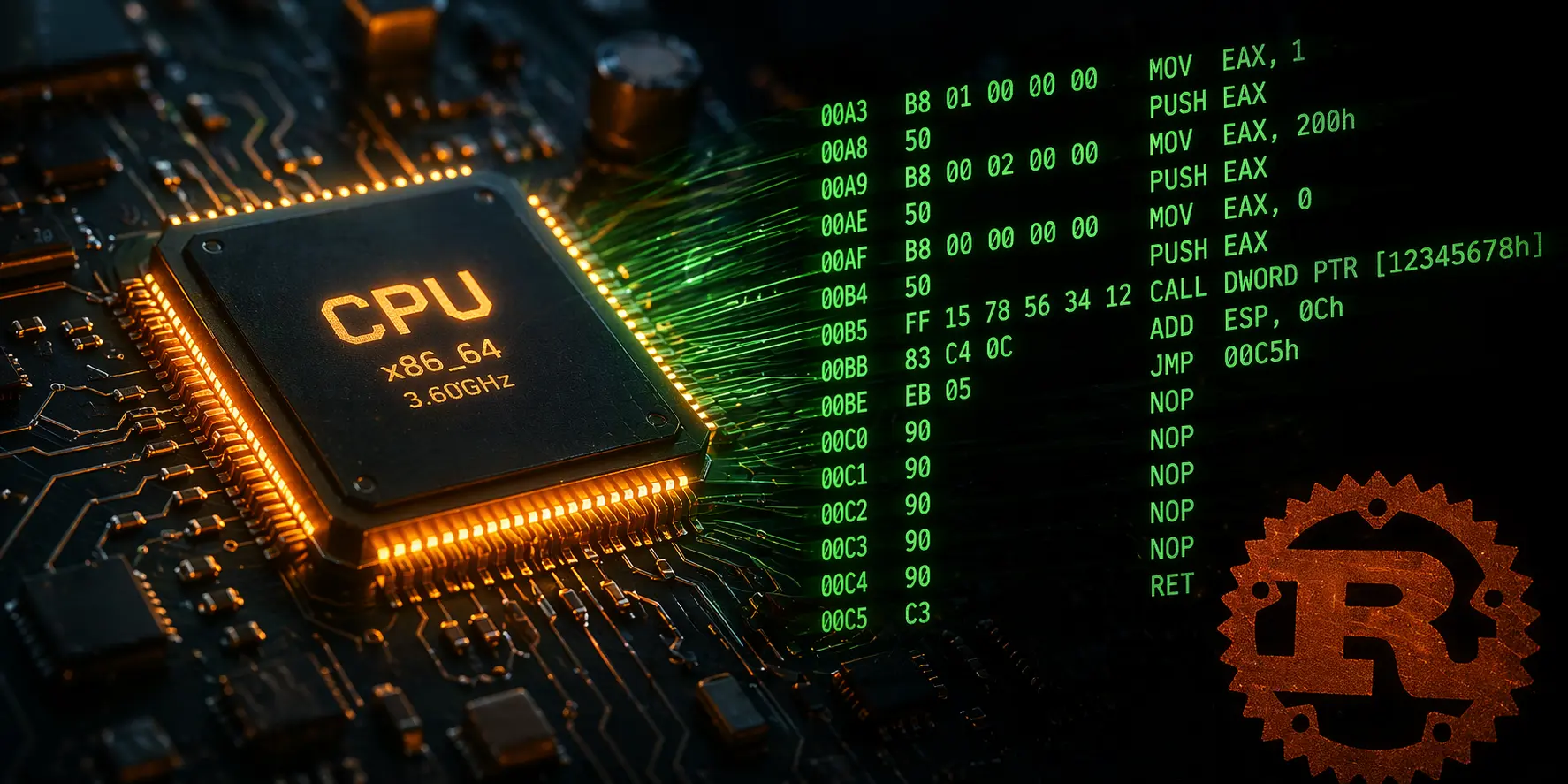
Learn Assembly
Talk directly to your CPU. Master x86-64 Assembly — registers, memory, system calls, and low-level control that no other language gives you.
Assembly in Action
Every example on CodeLearn Pro shows real, annotated Assembly code with expected output.
section .data
    msg  db  "Hello, World!", 10
    len  equ $ - msg

section .text
    global _start

_start:
    ; write syscall
    mov rax, 1        ; sys_write
    mov rdi, 1        ; stdout
    mov rsi, msg      ; buffer
    mov rdx, len      ; length
    syscall

    ; exit syscall
    mov rax, 60       ; sys_exit
    xor rdi, rdi      ; exit code 0
syscall; 64-bit general-purpose registers
mov rax, 42 ; RAX = 42
mov rbx, rax ; RBX = RAX (42)
mov rcx, 0xFF ; RCX = 255
; 32-bit sub-registers (zero-extends upper 32 bits)
mov eax, 10 ; EAX = 10, RAX upper = 0
; 8-bit sub-registers
mov al, 5 ; lower byte of RAX = 5
mov ah, 3 ; high byte of AX = 3mov rax, 20
mov rbx, 7
add rax, rbx ; RAX = 27 (sets ZF, SF, CF, OF)
sub rax, rbx ; RAX = 20
imul rax, rbx ; RAX = 140 (signed multiply)
; Compare & conditional jump
cmp rax, 100
jg .greater ; jump if RAX > 100
jl .less
jmp .equal
.greater:
; ... handle greater caseWhat You'll Learn
Six modules covering the full Assembly language skillset.
Basics & Syntax
- Program structure
- Sections (.data, .bss, .text)
- Comments & labels
- NASM vs GAS syntax
Registers
- General-purpose registers
- 64-bit vs 32-bit modes
- Special registers (RSP, RBP, RIP)
- Flags register
Instructions
- MOV, ADD, SUB, MUL
- CMP & conditional jumps
- PUSH / POP stack ops
- LEA & addressing modes
Memory & Addressing
- Stack vs heap
- Direct & indirect addressing
- Arrays & pointers
- String operations
System Calls
- Linux syscall table
- Writing to stdout
- Reading stdin
- Exit codes
Advanced
- Procedures & calling convention
- Interfacing with C
- Inline assembly
- SIMD / SSE basics

Explore the full category
Assembly is one of four languages in the Systems category. Also learn C, C++ and Rust to complete your low-level toolkit.
Frequently Asked Questions
Which assembler should I learn?
NASM (Netwide Assembler) is the most beginner-friendly and widely documented. GAS (GNU Assembler) uses AT&T syntax and comes pre-installed on Linux. Start with NASM.
Is Assembly still used in 2025?
Absolutely. Assembly is essential in embedded systems, OS kernels, firmware, game engines (SIMD optimisation), compilers, and cybersecurity / reverse engineering.
x86 or x64?
Learn 64-bit (x86-64 / AMD64) — it is the standard on all modern desktops, laptops and servers. The concepts transfer directly from 32-bit x86.
Do I need to know C first?
It helps but isn't required. However, knowing C makes it much easier to understand calling conventions, stack frames and interfacing with operating systems.
Ready to talk to the CPU?
Start the Assembly language course — free, no signup, no fluff.
Start Learning AssemblyNo account required · Always free
The Story of Assembly
Real history, real companies, and an honest look at where Assemblyshines and where it doesn't — not just a feature list.
Where it came from
Assembly language dates back to the earliest electronic computers of the 1940s and 50s — it's essentially a human-readable stand-in for the raw binary instructions a CPU actually executes, with one assembly instruction typically corresponding to exactly one machine instruction. Unlike every other language on this site, it's not one universal language — each CPU architecture (x86, ARM, RISC-V) has its own assembly dialect.
How it’s actually used today
Almost nobody writes entire applications in assembly today — compilers for C, Rust and others generate it automatically and usually do a better job than a human would. Where it still matters directly: CPU and compiler engineers writing the tools everyone else relies on, security researchers reverse-engineering malware, game console emulator authors, and anyone squeezing the last cycles out of a performance-critical inner loop.
Strengths & trade-offs
Nothing gives you more precise control over exactly what a CPU does, which makes assembly the ultimate teaching tool for understanding how computers actually work underneath every abstraction. The trade-off is total: no portability between CPU architectures, extremely verbose code for even simple tasks, and a genuinely steep learning curve with little day-to-day practical payoff for most developers.
What to learn next
Most people learn assembly specifically to understand how C compiles down to machine instructions, so C is the natural companion rather than a strict prerequisite. If you're drawn to this level of the stack, computer architecture and operating systems concepts are the deeper rabbit hole worth exploring next.