Enterprise
& JVM
The platform that runs the world's banks, hospitals, stock exchanges and Fortune 500 companies. Java and Scala on the JVM power more production systems than any other platform in history.
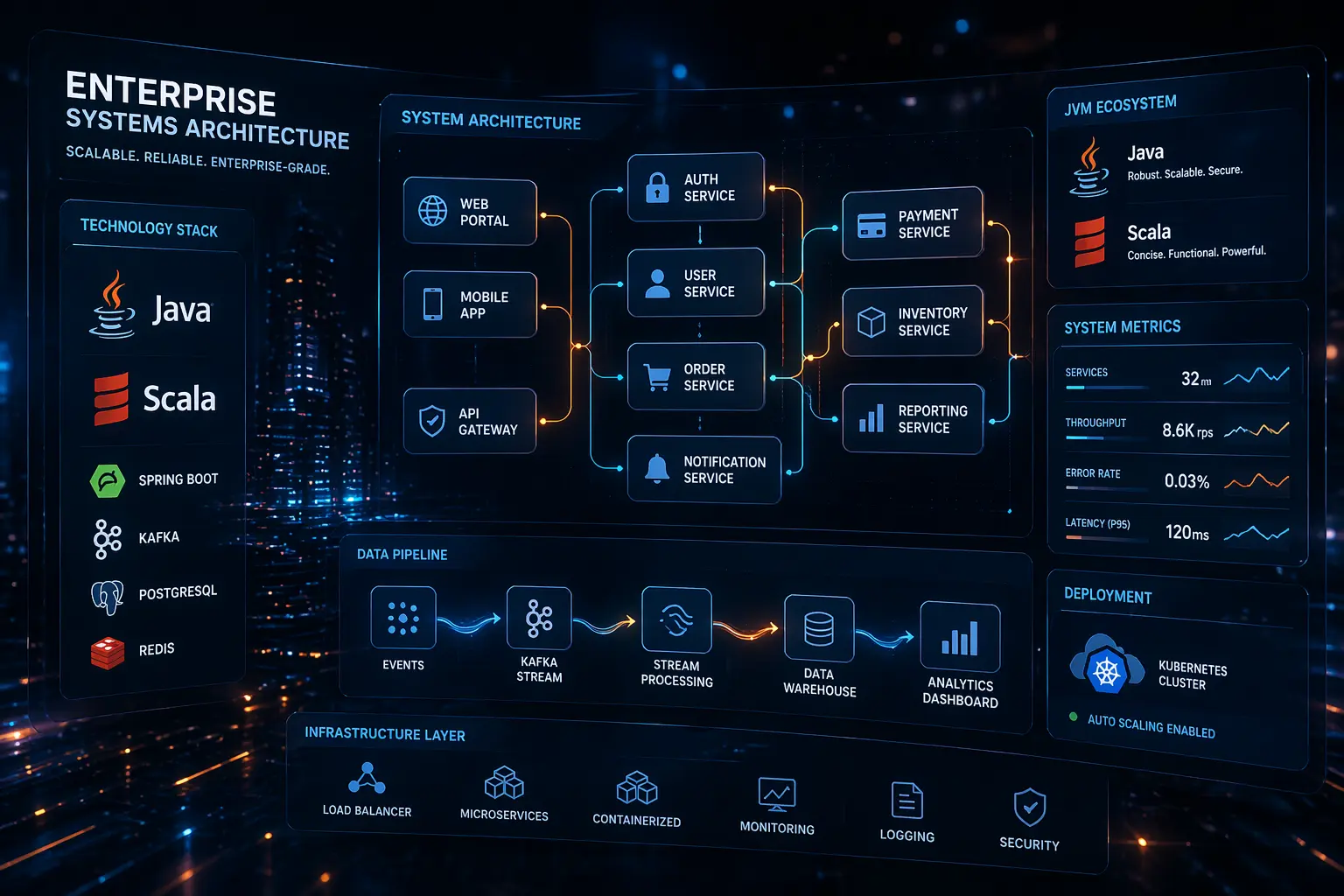
2 Languages
Explore the languages
Java
since 1995 · Enterprise & AndroidObject-oriented language that runs on the JVM. Powers enterprise applications, Android development, big data systems and some of the largest codebases on earth.
Scala
since 2004 · Big data & FPCombines object-oriented and functional programming on the JVM. The language behind Apache Spark — the world's most popular big data processing framework.
Why the JVM?
The platform that runs the world
Common questions
FAQ — Enterprise & JVM
Should I learn Java or Kotlin for Android development?
Google officially recommends Kotlin as the preferred language for Android development. However, Java still powers millions of Android apps and is worth knowing. If you are starting fresh, learn Kotlin. If you are joining a project with existing Java code, learn Java first.
Is Java still worth learning in 2026?
Absolutely. Java consistently ranks in the top 3 most-used languages worldwide. Spring Boot is the dominant framework for building enterprise APIs and microservices. Java developers are among the most in-demand, especially in finance, insurance, healthcare and government sectors.
What is the JVM and why does it matter?
The JVM (Java Virtual Machine) is a runtime that executes JVM bytecode. It's what makes Java platform-independent — write once, run on any OS. Importantly, multiple languages compile to JVM bytecode: Java, Kotlin, Scala, Groovy and Clojure all run on the JVM, sharing its mature performance and tooling.
What is Scala used for in industry?
Scala is the language of Apache Spark, which processes petabytes of data at companies like Netflix, Uber and Airbnb. It is also popular in quantitative finance for building type-safe, high-performance trading systems. The Play Framework uses Scala for building reactive web applications.
Is Scala harder than Java?
Yes. Scala has a steeper learning curve because it supports both object-oriented and functional programming paradigms, and its type system is significantly more powerful. Most Scala developers recommend learning Java (or another OOP language) first, then transitioning to Scala.
Related categories
Start your Java journey today
The language of enterprise. No signup, no cost, code examples with output ready to study.
Beyond the basics
Making sense of Enterprise & JVM
How these languages relate
Java and Scala both run on the Java Virtual Machine and can call each other's code directly, but they represent different philosophies: Java is explicit, verbose and extremely stable, prioritising long-term maintainability for codebases that last decades. Scala layers functional programming on top of the same JVM foundation, favouring conciseness and mathematical rigor over Java's plain explicitness.
How to choose
Learn Java first if you're aiming for enterprise or backend roles broadly — it's the more widely hired-for skill and the concepts transfer directly to Scala later if you need it. Go straight to Scala only if your specific goal is big-data engineering with Apache Spark, since that's the dominant real-world reason people choose Scala over Java today.
What's changing right now
Java itself has changed considerably in recent years — modern versions (17 and later) have added features like records and pattern matching that reduce the verbosity Java was historically criticised for, narrowing the practical gap with newer JVM languages like Kotlin and Scala.