Database
Programming
Every application stores data. Learn to design, query and manage databases — from relational SQL to document-based NoSQL and blazing-fast in-memory stores.
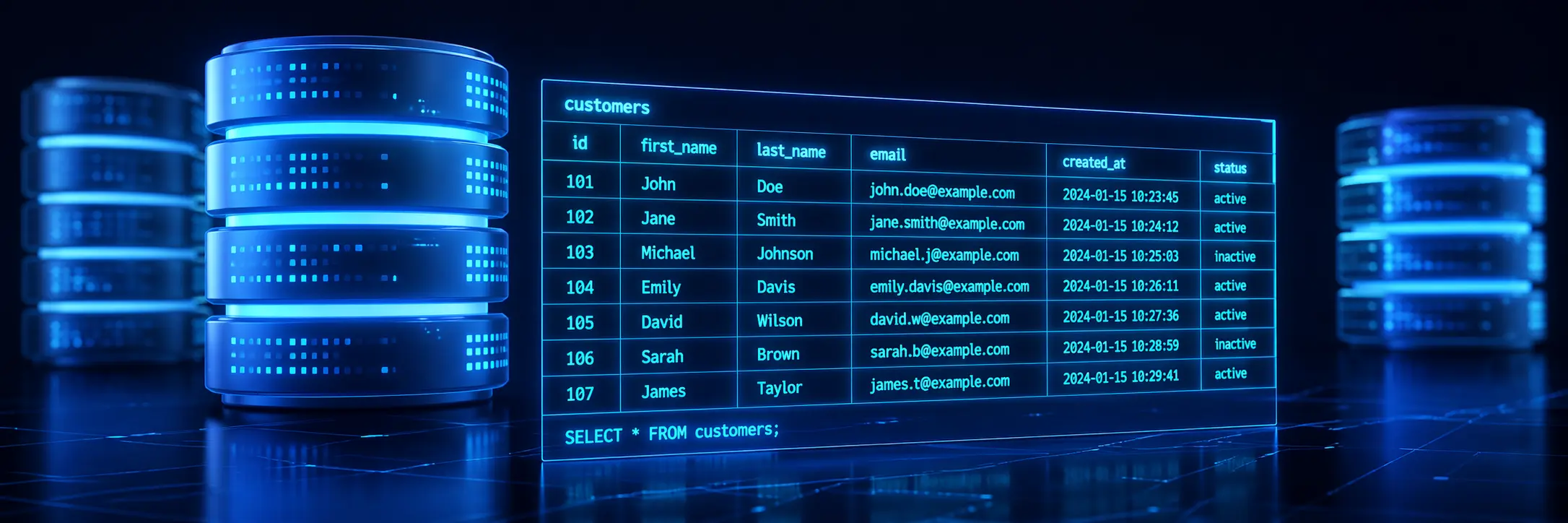
Pick the right tool
Which database for your use case?
4 Databases
Explore the databases
SQL
RelationalStandard language for managing and querying relational databases. Used in every major company on earth — from startups to Fortune 500.
PostgreSQL
RelationalThe world's most advanced open-source relational database. Full SQL compliance, JSON support, extensions and enterprise-grade reliability.
MongoDB
Document (NoSQL)Document-oriented NoSQL database storing data as flexible JSON-like documents. Perfect for rapidly changing data structures and modern apps.
Redis
In-memoryBlazing-fast in-memory data store. Used as a cache, message broker, session store and real-time leaderboard by companies like Twitter, GitHub and Snapchat.
Live in your browser
SQL runs without installing anything
Every SQL and PostgreSQL example on CodeLearn Pro uses sql.js — SQLite compiled to WebAssembly. Your query runs entirely in the browser, results appear instantly, no server needed.
Try SQL now →Common questions
FAQ — Databases
Should I learn SQL or MongoDB first?
Start with SQL. Relational databases are the foundation of data storage, and SQL is required knowledge in virtually every software job. Once you understand tables, joins and queries, document databases like MongoDB become much easier to understand by contrast.
What is the difference between SQL and PostgreSQL?
SQL is the language (Structured Query Language). PostgreSQL is a database system that uses SQL. Think of it like the difference between English and a book written in English. Other systems like MySQL and SQLite also use SQL with slight variations.
When should I use MongoDB instead of SQL?
Use MongoDB when your data has no fixed structure (fields vary per record), when you need to store nested/hierarchical data naturally, or when you're prototyping quickly and don't know your schema yet. Use SQL when data relationships matter and consistency is critical.
What is Redis used for in real applications?
Redis is primarily used as a cache (store query results in memory so you don't hit the database on every request), session storage (keep user login state fast), rate limiting (count API calls per user), pub/sub messaging (real-time notifications) and leaderboards (sorted sets).
Can I run SQL in my browser without installing anything?
Yes — CodeLearn Pro uses sql.js (SQLite compiled to WebAssembly) to run all SQL examples directly in your browser. No database server, no installation required. Write a query and see the results instantly.
Related categories
Query your first database today
SQL runs live in your browser. No setup, no login, no cost.
Beyond the basics
Making sense of Databases
How these languages relate
SQL is the query language, not a database itself — PostgreSQL is one specific, popular database engine that speaks SQL. MongoDB takes a different approach entirely, storing flexible JSON-like documents instead of rigid tables. Redis is different again: an in-memory store built for speed, almost always used alongside a slower, permanent database rather than instead of one.
How to choose
Start with SQL regardless of what you build later — it's the query language behind the vast majority of production databases, including ones that aren't PostgreSQL specifically (MySQL, SQL Server, SQLite all use close variants of it). PostgreSQL is the natural next step once you want to build something real. Reach for MongoDB specifically when your data doesn't fit neatly into tables — deeply nested, frequently changing structures. Add Redis once you have a real performance bottleneck to solve, not before.
What's changing right now
Managed, serverless database platforms (Supabase and Neon for PostgreSQL, MongoDB Atlas) have made it dramatically easier to get a production-grade database running without managing a server yourself, which has lowered the barrier to using 'serious' databases even for small side projects.