Data Science
& AI
Turn raw data into insight, predictions and intelligence. Learn the languages, libraries and workflows powering modern machine learning, statistical analysis and scientific computing.
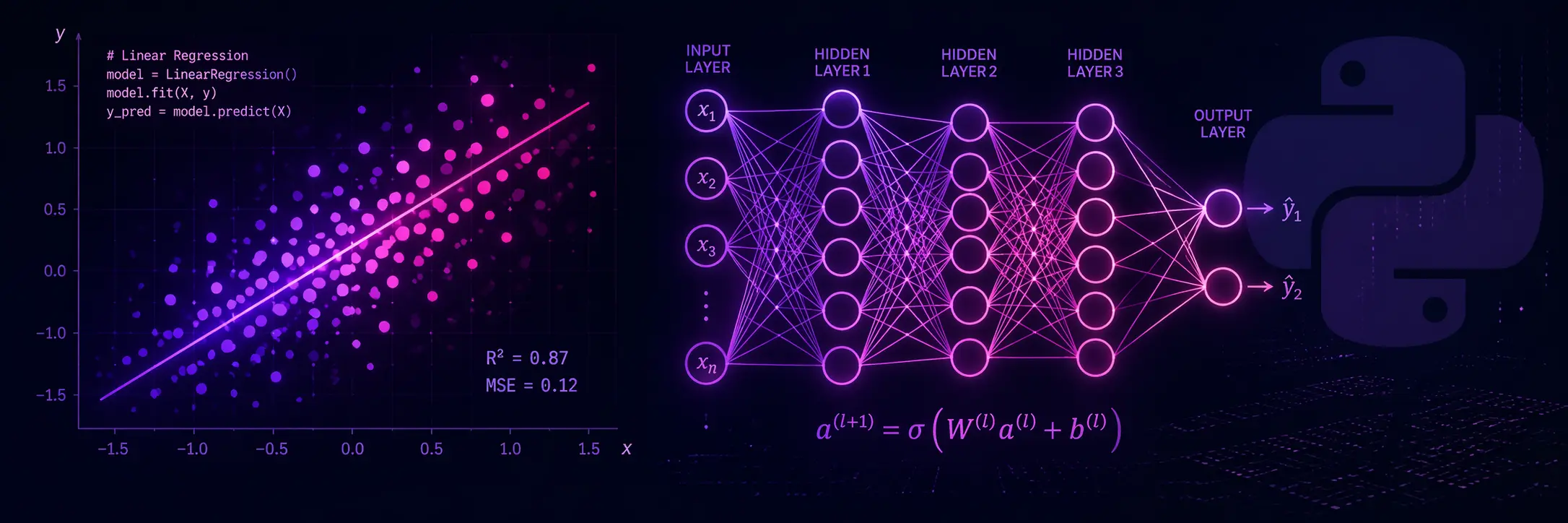
The process
The data science workflow
3 Languages
Explore the languages
Python (DS)
Python for data analysis, visualisation and machine learning. Powered by pandas, numpy, scikit-learn, matplotlib and the entire scientific Python ecosystem.
R
Statistical computing language built by and for statisticians. The standard in academia, bioinformatics and quantitative research.
Julia
High-performance language for numerical and scientific computing. Runs as fast as C while feeling as easy as Python — used in finance, physics and genomics.
Common questions
FAQ — Data Science & AI
Should I learn Python or R for data science?
Learn Python first. It's more versatile (you can also build web apps and automate tasks), has a larger community, and more job listings explicitly ask for Python. R is the better choice if your work is primarily statistical analysis or you're entering academia or bioinformatics.
Do I need a maths or statistics background to learn data science?
Basic statistics helps — concepts like mean, standard deviation, probability and linear regression appear constantly. However, you can start coding in pandas and numpy without deep maths knowledge, and build your statistical understanding alongside your coding skills.
Can I run Python data science code in my browser?
Yes. CodeLearn Pro uses Pyodide — Python compiled to WebAssembly — to run Python examples directly in your browser. This includes numpy and pandas. Click Execute and your data science code runs instantly, no installation required.
What is Julia used for and who uses it?
Julia is used in high-performance scientific computing, quantitative finance, computational biology, physics simulations and machine learning research. Major users include NASA, the Federal Reserve, MIT, and pharmaceutical companies. It is not a beginner language, but it is the fastest option for numerical work.
What is the difference between data science and machine learning?
Data science is the broader field of extracting insights from data — which includes data cleaning, visualisation, statistics and ML. Machine learning is a specific subset where algorithms learn patterns from data to make predictions. All ML is data science, but not all data science is ML.
Related categories
Start analysing data today
Python runs live in your browser via WebAssembly. No install, no login, no cost.
Beyond the basics
Making sense of Data Science & AI
How these languages relate
Python (via pandas, NumPy and scikit-learn), R and Julia overlap heavily in purpose but come from different communities. Python's data science tools grew out of general-purpose programming and are now the industry default. R was purpose-built for statistics from day one and remains the standard in academic biostatistics. Julia is the newest, aiming to remove the need to drop into a faster language like C for performance-critical numerical work.
How to choose
If you're aiming for an industry data science or machine learning role, Python is the safer choice — it's what most companies hire for and what most ML libraries (TensorFlow, PyTorch) are built around. If your work is specifically academic statistics or biostatistics, R's specialised statistical packages and academic community support are hard to beat. Julia is worth learning specifically if you're doing heavy numerical simulation and performance genuinely matters.
What's changing right now
The rise of large language models has pulled data science work increasingly toward Python specifically, since virtually every major AI framework and API — OpenAI's, Anthropic's, Google's — ships a Python SDK first, often with other languages catching up later or not at all.